
“Technical notes compiled with the assistance of ChatGPT.”
| B Polyacetal Practical comparison Property | POM-H Homopolymer | POM-C Copolymer | Modified / Terpolymer POM |
| Stiffness | Highest | Slightly lower | Depends on grade |
| Tensile strength | Highest | Slightly lower | Depends on filler |
| Thermal stability | Lower | Better | Usually improved |
| Chemical resistance | Good | Better | Grade-dependent |
| Hot-water resistance | Moderate | Better | Grade-dependent |
| Wear resistance | Excellent | Excellent | Can be superior |
| Risk of degradation | Higher | Lower | Usually lower |
| Centre-line porosity | More likely | Less likely | Grade-dependent |
| Processing safety margin | Narrower | Wider | Usually wider |
Important processing notes
Acetal must never be mixed with PVC, halogenated materials, strong acids, or contaminated regrind, because decomposition can produce formaldehyde and acidic gases. Also avoid excessive residence time and overheating.
Typical processing temperatures are roughly:
- POM-C: about 180–210°C
- POM-H: about 190–215°C
The exact temperatures depend on the supplier’s grade.
In simple terms
- POM-H: strongest and stiffest, but more sensitive.
- POM-C: more stable and chemically resistant; often the safer general-purpose choice.
- Modified / terpolymer POM: tailored grades for wear, impact, UV, glass reinforcement, low friction, or special applications.
Top of Form
The backbone of acetals, meaning POM / polyoxymethylene, is mainly an alternating carbon–oxygen chain:
–CH₂–O–CH₂–O–CH₂–O–
or written as the repeating unit:
[–CH₂–O–]ₙ
So the backbone is not a normal carbon–carbon chain like polyethylene. It is a polyether-type backbone made from repeated methylene oxide units.
1. Acetal homopolymer backbone — POM-H
The homopolymer is almost entirely:
[–CH₂–O–]ₙ
This gives it a very regular chain structure, which allows high crystallinity.
That is why POM-H usually has:
- high stiffness
- high tensile strength
- good fatigue resistance
- good creep resistance
- relatively high shrinkage
- possible centre-line porosity in thick mouldings
2. Acetal copolymer backbone — POM-C
The copolymer is mostly the same:
–CH₂–O–CH₂–O–CH₂–O–
but with occasional comonomer units inserted, commonly from ethylene oxide or dioxolane chemistry.
Simplified:
–CH₂–O–CH₂–O–CH₂–CH₂–O–CH₂–O–
The occasional –CH₂–CH₂–O– unit interrupts the perfect POM chain.
This slightly reduces crystallinity, but improves:
- thermal stability
- processing safety
- resistance to hot water
- resistance to alkalis
- resistance to unzipping degradation
Why the backbone matters
The –CH₂–O– backbone is strong and regular, but it has one important weakness: under heat, acid contamination, or incorrect processing, the chain can “unzip” and release formaldehyde.
That is why acetals must be processed carefully and kept away from materials such as PVC, acids, and contaminated regrind.
In simple terms:
Acetal has a repeating carbon–oxygen backbone: –CH₂–O–.
The homopolymer is very regular and strong; the copolymer has occasional interruptions that improve stability.
- Top of FormBottom of Form
B, Polyketones
Polyketones are a family of engineering thermoplastics where the polymer backbone contains ketone groups:
–CO–
The ketone group is very polar and stiff, which gives polyketones good mechanical strength, chemical resistance, and heat performance.
There are two main groups worth separating:
1. Aliphatic polyketone — PK
This is the newer commercial “polyketone” most often meant in plastics processing.
Basic structure
It is commonly made from carbon monoxide + ethylene, sometimes with a small amount of propylene.
Simplified structure:
–CH₂–CH₂–CO–CH₂–CH₂–CO–
So the chain has regular alternating hydrocarbon and ketone units.
A terpolymer version contains some propylene units:
ethylene + propylene + carbon monoxide
This improves processability and modifies melting point and toughness.
Main properties of aliphatic PK
Polyketone has a very interesting balance of properties:
| Property | General behaviour |
| Strength | High |
| Stiffness | Good, usually between PA and POM |
| Toughness | Very good |
| Wear resistance | Excellent |
| Chemical resistance | Excellent, especially to fuels and hydrocarbons |
| Hydrolysis resistance | Better than polyamides |
| Moisture absorption | Much lower than nylon |
| Barrier properties | Very good |
| Fatigue resistance | Good |
| Creep resistance | Good |
| Processing | Injection moulding and extrusion possible |
Advantages compared with nylon
Compared with PA6 or PA66, aliphatic polyketone usually has:
- much lower moisture absorption
- better dimensional stability in humid conditions
- better fuel and chemical resistance
- very good wear and friction behaviour
- good toughness without needing absorbed moisture
This makes it useful where nylon changes dimensions or properties because of water absorption.
Advantages compared with acetal
Compared with POM/acetal, polyketone can offer:
- better resistance to some chemicals
- better impact toughness
- better barrier properties
- good wear properties
- no formaldehyde-type decomposition issue like POM
However, acetal may still be better for some very precise, low-friction, low-creep applications.
Typical applications
- fuel-system components
- gears
- wear strips
- conveyor parts
- pump components
- valve components
- electrical/electronic parts
- under-bonnet automotive parts
- tubing and pipe applications
- food-contact components, depending on grade approval
Filled grades
Like nylon, PK can be compounded with:
- glass fibre
- carbon fibre
- PTFE
- mineral fillers
- impact modifiers
- flame retardants
- lubricants
Glass-filled PK can become a very strong, stiff, dimensionally stable engineering material.
2. Aromatic polyketones — PEEK, PEK, PEKK, PEKEKK
These are high-performance polymers, not usually called simply “polyketone” in normal trade, but chemically they are polyketones because they contain ketone groups.
Examples:
- PEEK — polyether ether ketone
- PEK — polyether ketone
- PEKK — polyether ketone ketone
- PEKEKK — polyether ketone ether ketone ketone
PEEK simplified structure
PEEK has aromatic rings, ether links and ketone links:
aryl–O–aryl–O–aryl–CO–
The aromatic rings give very high heat resistance and stiffness.
Properties of aromatic polyketones
| Property | Behaviour |
| Heat resistance | Excellent |
| Continuous service temperature | Very high |
| Chemical resistance | Excellent |
| Mechanical strength | Very high |
| Wear resistance | Excellent |
| Flame resistance | Naturally good |
| Cost | Very high |
| Processing temperature | Very high |
PEEK, for example, is processed at much higher temperatures than normal engineering plastics, often around 360–400°C melt temperature, depending on grade.
Typical applications
- aerospace components
- medical implants
- high-temperature electrical parts
- oil and gas components
- compressor parts
- high-performance bearings
- high-temperature gears
- seals and back-up rings
Simple comparison with common engineering plastics
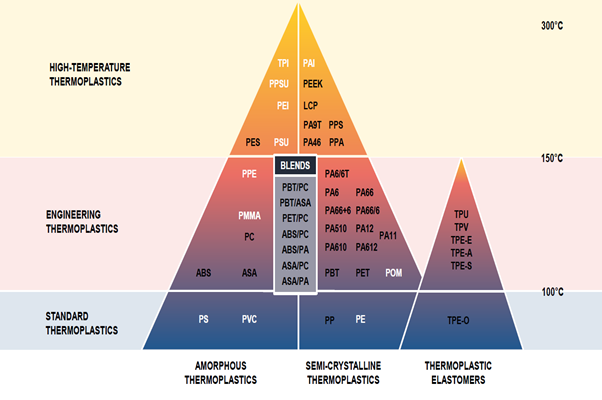
| Material | Main character |
| PA6 / PA66 | Strong and tough, but absorbs water |
| POM / Acetal | Very good dimensional precision and low friction |
| PK / Aliphatic polyketone | Tough, chemically resistant, low moisture uptake, excellent wear |
| PBT | Good electrical and dimensional properties |
| PPS | Higher heat and chemical resistance |
| PEEK | Very high-performance, very expensive |
Practical processing notes for aliphatic PK
Aliphatic polyketone generally processes more like an engineering thermoplastic than like PEEK.
Typical considerations:
- Drying may be required depending on supplier recommendation and storage conditions.
- Avoid excessive residence time.
- Use corrosion-resistant tooling if processing chemically aggressive compounded grades.
- Glass-filled grades will be abrasive to screws, barrels and non-return valves.
- Mould temperature control is important for crystallinity, shrinkage and surface finish.
Important point
When someone says “polyketone” in normal plastics business today, they usually mean aliphatic polyketone PK, not PEEK. PEEK is technically an aromatic polyketone, but commercially it is usually referred to by its own name.
In simple terms:
Polyketone PK is a tough, chemically resistant, low-moisture engineering plastic that sits between nylon, acetal and higher-performance polymers.
Warning: Ketones should not be processed with contaminated with PVC as this can result in dehydrochlorination with HCl gas emitted.
Compliments of Composite Plastics of Johannesburg
Leave a Reply